
Thinking about getting a battery-powered rope ascender? It can be a game-changer for anyone who works at heights or needs to move up and down ropes often. These gadgets make climbing way easier, faster, and safer than old-school methods. But with so many options out there, picking the right one can feel a bit much.
This guide will walk you through what to look for, how they work, and what makes a good battery-powered rope ascender stand out, so you can make a smart choice.
What Is A Battery Powered Rope Ascender?
Okay, so what are these things? Simply put, a battery-powered rope ascender is a motorized device that helps you climb ropes. Forget hauling yourself up manually; this tool does the work for you.
It uses a battery-operated motor to grip the rope and pull you upwards (or control your descent). Think of it like an electric winch, but designed specifically for climbing. We’re talking about a game-changer for anyone who works at height.
Key Benefits Of Power Ascenders:
Why bother with a battery powered ascender? Here’s the lowdown:
- Efficiency: They make ascending and descending way faster and easier.
- Reduced Fatigue: Save your energy for the actual work, not just getting there.
- Safety: Controlled ascents and descents can minimize risks.
- Versatility: Many models can also be used as winches for lifting gear.
Using a power ascender can really change how you approach vertical work. It’s not just about making things easier; it’s about working smarter and safer.
So, how do these things actually work? Most ascenders use a motor-driven system to grip the rope. This might involve rollers, cams, or other mechanisms that create friction. The motor is powered by a rechargeable battery, and controls usually allow for variable speed.
Some models even have a bidirectional operation, meaning they can ascend and descend. It’s a pretty neat piece of engineering, really. The Ronin Lift, for example, allows climbers to ascend and descend without detaching from their saddle.
Key Features To Look For In A Battery Powered Rope Ascender
When we’re choosing a battery-powered rope ascender, it’s easy to get lost in the specs. But focusing on a few key features can make all the difference. We need something that’s safe, reliable, and makes our work easier. Let’s break down the must-haves.
- Weight Capacity And Lifting Power
First up, weight capacity. This isn’t just about our weight; it’s about all the gear we’re carrying. We need to make sure the ascender can handle the total load without straining. Lifting power is also key – how quickly can it lift us and our equipment? A slow ascender can waste a lot of time, especially on long climbs. For example, the AWAH Z3 Prof is a lightweight option with a 200 kg capacity.
- Battery Life And Hot-Swappable Options
Battery life is a big deal. We don’t want to be stuck halfway up a structure with a dead battery. Look for ascenders with long-lasting batteries, and even better, hot-swappable options. This lets us change batteries without powering down the device, keeping us moving. Consider these points:
- Battery life should match the typical duration of our tasks.
- Hot-swappable batteries minimize downtime.
- Check the charging time – a quick charge can be a lifesaver.
- Durability And Weather Resistance
Our gear takes a beating, so durability is non-negotiable. The ascender needs to withstand rough handling, exposure to the elements, and constant use. Weather resistance is also essential. Rain, snow, or extreme temperatures can all affect performance. Look for ascenders made from tough materials with sealed components.
- Bidirectional Operation And Speed Control
Being able to go up and down is essential. The bidirectional operation allows us to ascend and descend without changing equipment. Speed control gives us even more flexibility. We can adjust the speed to match the task, whether it’s a slow, controlled descent or a rapid ascent.
Having precise control over speed and direction is a game-changer. It not only improves efficiency but also enhances safety, especially in tricky situations. Being able to fine-tune the ascender’s performance to the specific demands of the job is invaluable.
Applications Of Battery Powered Rope Ascenders
We’ve seen how battery powered ascenders are changing the game for arborists. Traditional climbing methods? They’re tough on the body and take a lot of time. A power ascender makes getting up into trees safer and faster.
- Increased safety for tree care tasks.
- Improved productivity in the field.
- More precision when working at height.
Battery power keeps these ascenders quiet and environmentally friendly, which is a big plus when you’re working in natural environments. Plus, hot-swappable batteries mean you can keep going all day.
In construction, time is money. Ronin Lift ascenders help us move materials and personnel quickly and safely. Think about it: no more struggling with heavy loads or slow manual systems.
- Building maintenance becomes faster.
- Window cleaning is more efficient.
- Inspections are easier to conduct.
These ascenders can be used as a primary access method, a backup for rescue situations, or integrated with existing equipment. Their weather resistance means we can keep working even when conditions aren’t ideal.
When lives are on the line, every second counts. Battery-powered ascenders give search and rescue teams a crucial edge. They’re faster, more efficient, and can handle heavier loads than traditional methods.
- Faster extraction of victims.
- Improved efficiency in helicopter operations.
- Increased capacity for two-person rescues.
Ladders and manual winches have their place, but a battery powered ascender can be a game-changer in critical situations. It can be used as a winch or a personal ascender, depending on the scenario.
Exterior access can be tricky, whether it’s for maintenance, inspections, or repairs. Battery powered ascenders make it easier and safer to reach those hard-to-get-to spots.
- Simplified building facade maintenance.
- Easier access for inspections.
- Improved safety for workers at height.
These ascenders provide complete freedom and efficiency, allowing us to move quickly regardless of the conditions. They can be used as a personal ascender or a winch to pull up equipment, making them perfect for a variety of exterior access tasks.
Safety Considerations For Battery Powered Rope Ascenders
Using the right rope is super important. Not all ropes are created equal, and not all are safe for use with a powered ascender. Always check the manufacturer’s list of approved ropes. Using the wrong rope can lead to slippage, damage to the rope, or even catastrophic failure.
We need to make sure the rope’s diameter, material, and construction are compatible with the ascender’s specifications. It’s not just about whether the rope fits; it’s about whether it can handle the stress and friction generated by the device.
Think you can just pick up a power ascender and go? Think again! Proper training is a must. We need to understand the device’s operation, limitations, and emergency procedures. Certification programs exist for a reason. They ensure we know how to use the equipment safely and effectively.
Here’s what training should cover:
- Basic operation and controls
- Emergency descent procedures
- Risk assessment and hazard identification
- Inspection and maintenance
Regular Maintenance And Inspections
Maintenance? Yeah, it’s boring, but it’s also life-saving. We need to inspect our power ascenders before each use. Look for wear and tear, damaged parts, or anything that seems off. Regular servicing by a qualified technician is also essential. Keep a log of inspections and maintenance to track the device’s condition.
Ignoring maintenance is like ignoring the check engine light in your car. It might seem okay for a while, but eventually, something will break, and it’ll probably be at the worst possible time. A little bit of preventative care goes a long way in ensuring our safety and the longevity of our equipment.
Maximizing Efficiency With Your Battery Powered Rope Ascender
We’ve found that integrating your new battery powered ascender with your current gear is key. Think about how it fits with your harness, ropes, and other tools. A smooth setup saves time and energy.
- Make sure your ascender is compatible with your rope diameter.
- Check the weight limits of all connected equipment.
- Practice setting up your system until it becomes second nature.
Ascending and descending efficiently is more than just pressing a button. It’s about technique. We’ve learned that smooth, controlled movements are less taxing on the battery and your body.
- Use a consistent rhythm during ascent.
- Control your descent speed to prevent overheating the motor.
- Consider using a foot ascender to complement the powered ascender.
Did you know your ascender can double as a winch? It’s a game-changer for hauling heavy gear. We’ve used this feature to lift equipment on construction sites and move heavy branches in tree care.
Just remember to respect the weight limits and use appropriate rigging techniques. Safety first, always.
Here’s a quick guide:
- Secure the load properly.
- Use pulleys to reduce the load on the ascender.
- Monitor the battery level during winching.
Accessories And Complementary Gear For Battery Powered Rope Ascenders
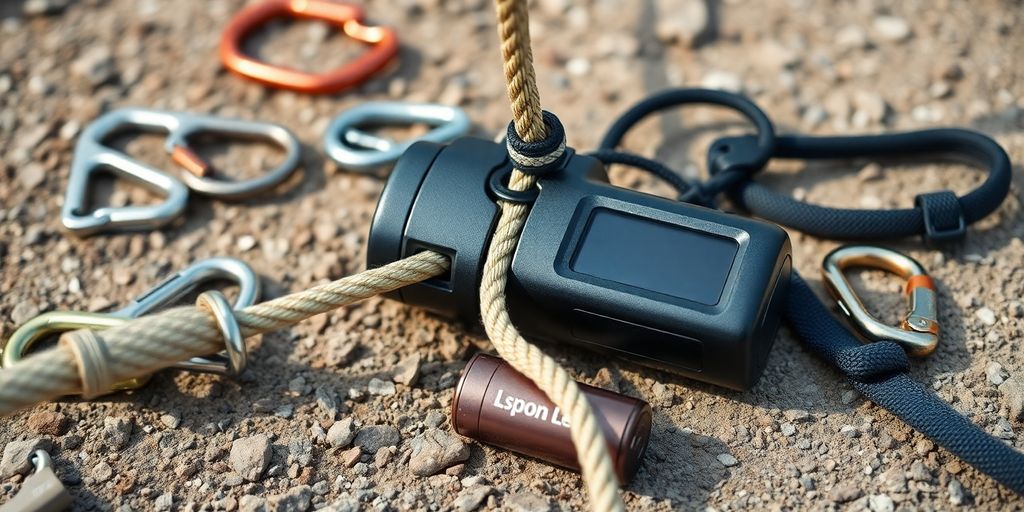
- Your harness is your lifeline. A comfortable, well-fitting harness is non-negotiable. Look for harnesses with multiple, reinforced attachment points. These points allow for balanced weight distribution and secure connections to your rope ascender and other gear.
Consider the type of work you’ll be doing; some harnesses are better suited for specific tasks like tree climbing or construction. It’s also worth checking out gear loops for easy access to tools.
- Prusik loops are simple but incredibly useful. They can act as backups, foot loops, or progress capture devices. Mechanical ascenders offer a more efficient way to ascend the rope, especially for longer distances.
Even with a battery-powered ascender, carrying a couple of prusik loops and a mechanical ascender is a smart move for redundancy and versatility. A VT Prusik is also a great option for canyoning.
- Pulleys are essential for creating efficient hauling systems. Whether you’re lifting equipment or assisting a partner, pulleys reduce the amount of force needed. A good pulley can make a huge difference.
Consider these points when choosing pulleys:
- Efficiency rating (look for 70% or higher).
- Weight and size (smaller pulleys are great for personal use).
- Compatibility with your rope diameter.
Pulleys are not just for heavy lifting; they also improve the smoothness and control of your rope system. Integrating pulleys into your setup can significantly reduce friction and strain, making your work easier and safer.
So, there you have it. Picking out a battery-powered rope ascender isn’t just about grabbing the first one you see. It’s really about figuring out what you need it for, how much you’ll use it, and what kind of features actually matter to you.
Consider the battery life, the weight it can lift, and its ease of use. Getting the right one can make a big difference in how safe and fast you get things done, whether you’re working high up or just having some fun. Take your time, do a little research, and you’ll find the perfect fit for your adventures.
Frequently Asked Questions
What exactly is a battery-powered rope ascender?
A battery-powered rope ascender is a special tool that helps people climb up ropes using a motor. It makes climbing much easier and faster than doing it by hand.
Where are these ascenders typically used?
These devices are super helpful in many jobs, like when tree doctors (arborists) need to climb tall trees, construction workers need to reach high places, or rescue teams need to quickly get to someone in trouble. They save time, energy, and make work safer.
What are the most important things to remember for safety when using these devices?
Safety is super important. Always use the right ropes that are approved for your ascender, get proper training on how to use it safely, and make sure to check and maintain your device regularly to keep it in good working order.


